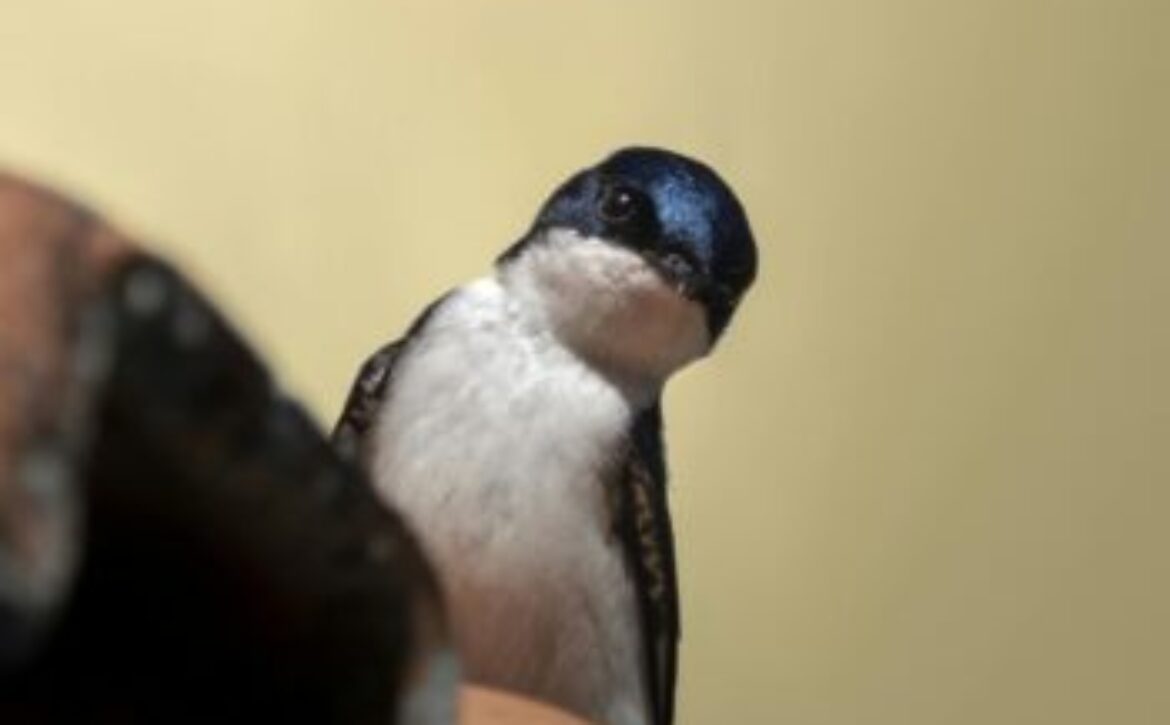
Helping house martins
‘House martins’ was a popular topic for the February meeting of our local Suffolk Wildlife Trust group, and Martin Tickler brought his expertise to explain how we can support the declining numbers of these charismatic birds.
The reasons for the reduction of house martins are many and complex: the dangers of migration, habitat loss, lack of invertebrate food, and most particularly, changes in house-building design. They are a summer visitor to the UK, arriving from Africa in late April, and leaving again in September. They choose sheltered spots, under the eaves of buildings, and their mud nests require a rough surface for secure attachment.
Martin offered suggestions that can help. House martins need wet, sticky mud, and in droughts this can be a challenge, so in some places, an area of mud can be kept watered for the birds to use. The prevalent use of PVC fascias and soffits are unsuitable for nests, and Martin brought examples of nest cups made from sustainable material that can be fixed in place under eaves. House martins are quite sociable, and there are often numbers of nests close to each other, with birds repairing or adding to old sites. They will adapt an artificial nest if need be, adding mud to make the entrance smaller, hoping to keep unwanted visitors out. There are dangers. Sparrows are known to invade and evict resident birds and chicks. Great spotted woodpeckers can rapidly destroy many nests, searching for food. Predators such as hobbies and sparrowhawks can snatch the unwary.
In a good season, house martins will have two, and sometimes three, broods a year, with two to six chicks. Both parents raise the young, helping them to fledge, and juveniles can be seen feeding younger chicks, so it is very much a family affair.
It was an entertaining and informative talk, and for those wishing to learn more, House Martin Support Suffolk can be found at www.suffolkbirdgroup.org.
The details for our next meeting are a little different. We will be at Wenhaston Village Hall IP19 9EQ, on Wednesday, 11th March at 7.30pm. Steve Aylward, from the SWT, will be taking us on a Botanical Tour of SWT reserves. The cost is £5, to include refreshments; under 25s free. Everyone is welcome.
Contact us at swtblythvalley@gmail.com.
Penny Mansfield